
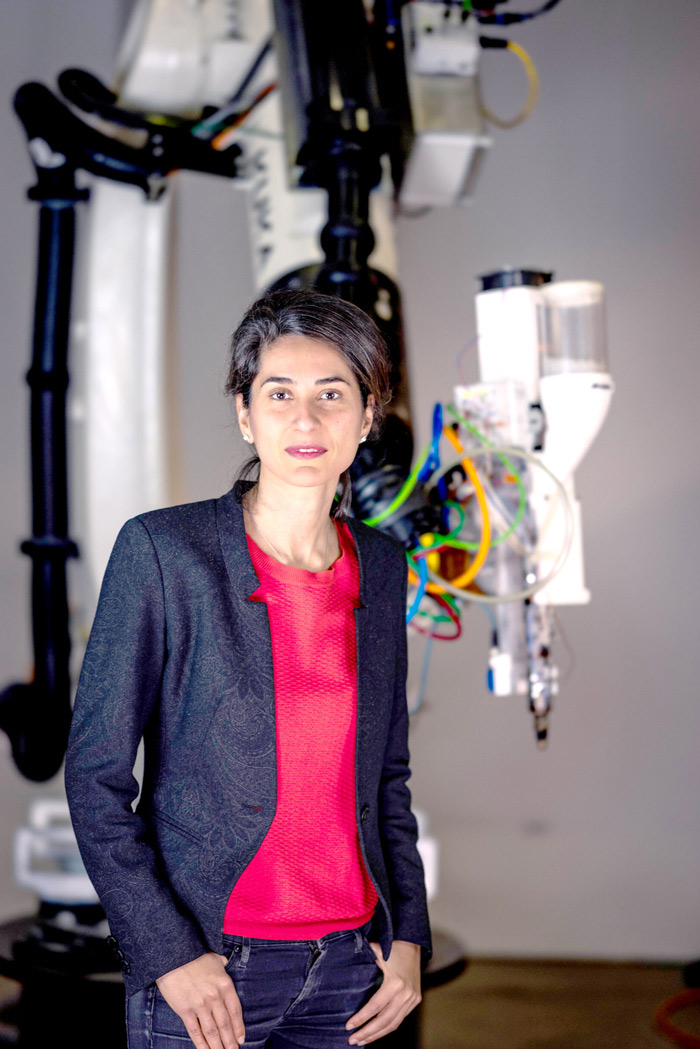
I’m Dr. Mania Aghaei Meibodi—an Assistant Professor at the University of Michigan’s Taubman College of Architecture & Urban Planning, Director of the Digital Architecture Research & Technologies (DART) Laboratory, and, by practice, a Swedish-licensed architect. My work sits at the intersection of computational design, artificial intelligence, data-driven modeling, and construction-scale robotic 3D printing. I develop AI-assisted generative design models and predictive, sensing-informed methods that connect the full chain—from design intent and simulation to toolpath planning, fabrication, assembly, and performance evaluation—so we can create solutions that address climatic challenges and reliably manufacture what we design.
At DART, my team and I advance generative computational design technologies and intelligent robotic construction systems to reinvent high-performance, next-generation structures and building elements. A core principle in my research is that technological development and architectural imagination must evolve together. The same advances that make predictive modeling, AI-enabled design, and robotic fabrication possible also require us to rethink what buildings can be—and to reimagine the geometric concept, new construction material, and performance goals of future building elements. My goal is to build foundational knowledge and scalable platforms for intelligent computational design and smart robotic 3D printing, enabling a new class of multifunctional, high-performance structures that are both feasible to fabricate and measurable in performance. This is demonstrated in multiple building elements: such as envelopes that actively reduce heat load, manage airflow, support rainwater runoff strategies, and increase biodiversity—where geometry and material distribution are tuned for performance, and fabrication is part of the intelligence of the system; or slabs and structural components that achieve maximum performance with minimal material, while opening opportunities to integrate additional functions—thermal regulation, acoustic behavior, sensing, or environmental exchange—directly into load-bearing building parts.
At the University of Michigan, I teach M.Arch (500) courses such as Computational Geometry, Advanced Computational Geometry, Advanced Computational Design, Computational Geometries, Digital Fabrication (Robotics) and Fabrication (Robotics) and; MS-DMT (700) courses such as Material Engagement (Robotics), System Engagement, and Capstone; and PhD-level (800) courses such as Doctoral Methods Seminar and Doctoral Theory Seminar.
Before joining the University of Michigan, I was a postdoctoral and senior researcher at ETH Zurich in the Digital Building Technologies group and the NCCR Digital Fabrication program. There, I contributed to the development of several landmark research prototypes and helped shape the group’s direction in digital fabrication. I led the Smart Slab project for the DFAB House, which demonstrated the architectural potential of 3D sand printing for full-scale construction through complex, performance-driven formwork. I also led the Deep Façade project, which introduced new opportunities for 3D-printed molds and revived the use of cast metal in architecture through advanced fabrication workflows. Prior to ETH Zurich, I designed and realized multiple timber structures in Sweden using robotic and digital fabrication methods—experiences that continue to influence how I connect material behavior, structural logic, and fabrication constraints in my research.
I earned my Master of Architecture and Ph.D. in Architectural Design and Technology from KTH Royal Institute of Technology (Sweden), and a Ph.D./Licentiate in Architectural Engineering from Luleå University of Technology (Sweden). I also hold a Bachelor of Applied Science in Architecture from Curtin University (Australia) and a Bachelor of Architecture from Limkokwing University of Creative Technology (Malaysia).
when I am not stuck in the lab, I’m usually cycling, hiking, kayaking, skiing, water skiing—and in between, I paint, develop properties, design furniture and buildings, and spend time with friends.